Temple Jewelry and Deity Adornment
ఈ మార్గదర్శిక ప్రస్తుతం ఆంగ్లంలో మాత్రమే అందుబాటులో ఉంది.
Few crafts capture the splendour of South Indian devotion as vividly as temple jewelry — opulent ornaments set with deep red kemp stones, glinting in gold against the dark stone of a sanctum or the silk of a dancer’s costume. Distinctive, ornate, and unmistakably sacred in origin, it is one of the region’s great artistic traditions.
Yet temple jewelry is not, at root, about human vanity. Its purpose begins with the deity: it was made to adorn the divine image, an expression of love poured out in gold and stone. This guide traces that origin, introduces the classic pieces and materials, and follows the tradition into the world of classical dance, where it lives on today.
Adorning the deity
The deeper meaning of temple jewelry lies in alankaram — the loving decoration of the deity. To dress and ornament the sacred image is treated as an act of devotion, the same impulse that prompts a devotee to offer the finest cloth, flowers, and ornaments to one held dearer than any earthly beloved. Temple jewelry was first crafted precisely for this: to adorn the fixed images and processional deities of the great temples.
Seen this way, the lavishness of temple jewelry is not excess but offering. The skill of the goldsmith, the richness of the stones, the weight and intricacy of the pieces — all are given to the Lord as the best that human craft can produce. The jewelry is beautiful, but its beauty is directed outward and upward, toward the divine it was made to honour.
The classic pieces and stones
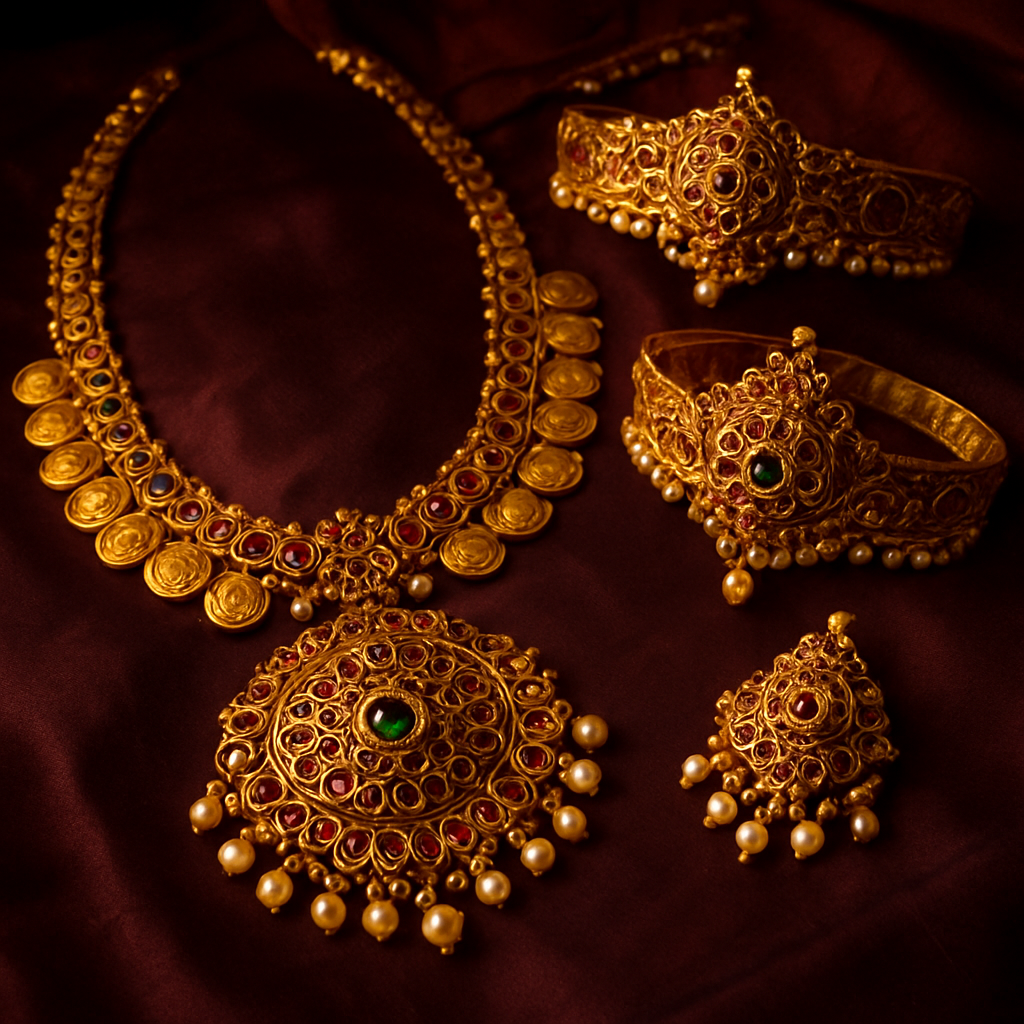
The tradition has a recognised vocabulary of pieces. The haram is the long necklace that falls across the chest; the vanki is the angled armlet worn on the upper arm; the oddiyanam is the ornate waist belt; and the nethichutti is the forehead ornament that traces the parting of the hair. Earrings, nose ornaments, and headpieces complete the ensemble.
The signature look comes from the stones and setting. Deep red kemp stones, often paired with green, are set into richly worked gold or gold-plated mounts, frequently accented with pearls. The motifs — peacocks, lotuses, swans, and temple gopuram forms — are drawn directly from the iconography of the temple itself, so that the jewelry carries the sacred imagery on the body.
In classical dance
The same jewelry that adorns the deity adorns the classical dancer. In Bharatanatyam and related traditions, the performer wears a full set of temple jewelry — haram, vanki, oddiyanam, nethichutti, and more — so that the dancer, who embodies sacred stories and offers the dance as worship, is arrayed in the ornaments of the temple.
This shared adornment is no coincidence: classical dance grew up within the temple, and its costume reflects that origin. The continuity means temple jewelry is a living craft rather than a museum piece — still made, still worn, and still carrying its devotional meaning each time a dancer steps onto the stage as an offering of the art.
దేని కోసం చూడాలి
- Traditional kemp (red) and green stones in classic settings
- Recognised pieces — haram, vanki, oddiyanam, nethichutti
- Secure clasps and settings that hold the stones firmly
- A finish (gold-plated or silver) suited to your use
- Motifs drawn from genuine temple and dance traditions
వీటిని ఎక్కడ కనుగొనాలి
Temple jewelry
Traditional temple jewelry features kemp stones and classical motifs used in deity adornment and dance.