Ekadashi Observance Through the Year
இந்த வழிகாட்டி தற்போது ஆங்கிலத்தில் மட்டுமே கிடைக்கிறது.
For devotees of Vishnu, the calendar has a steady, recurring heartbeat: Ekadashi, the eleventh day of each lunar fortnight, observed as a day of fasting, restraint, and turning toward the Lord. Returning roughly every two weeks, it is among the most regular of all Vaishnava observances — a discipline woven through the whole of the year rather than reserved for a single festival.
Far from being a burden, Ekadashi is cherished as a gift: a fixed point of pause and purification that keeps devotion alive between the great festivals. This guide explains why Ekadashi recurs twice a month, how it is traditionally kept, and how the named Ekadashis give shape and colour to the devotional year.
Twice each month
A lunar month is divided into two fortnights — the waxing (Shukla) and the waning (Krishna) paksha — and each contains an eleventh day. There are therefore two Ekadashis in every lunar month, one as the moon grows toward full and one as it wanes toward new, giving roughly twenty-four across the year.
This regular recurrence is part of what makes Ekadashi so formative for devotees. It is frequent enough to become a genuine rhythm of life, a discipline returned to again and again, yet spaced so that each observance retains its meaning. The fortnightly return turns devotion from an occasional event into a sustained practice.
The named Ekadashis
While every Ekadashi shares the same basic character, many carry their own names, stories, and special significance. Vaikuntha Ekadashi, in the month of Margazhi, is the most celebrated, the day the gate of heaven is said to open. Nirjala Ekadashi is kept as a complete fast without even water, and is held to carry the merit of all the year’s Ekadashis at once.
Others — Putrada, Mokshada, Devshayani, and more — each have their own legends, drawn largely from the Puranas, and their own associated blessings. Learning the named Ekadashis gives the devotional year a kind of map, each fortnight’s observance carrying its particular story and grace.
How it is kept
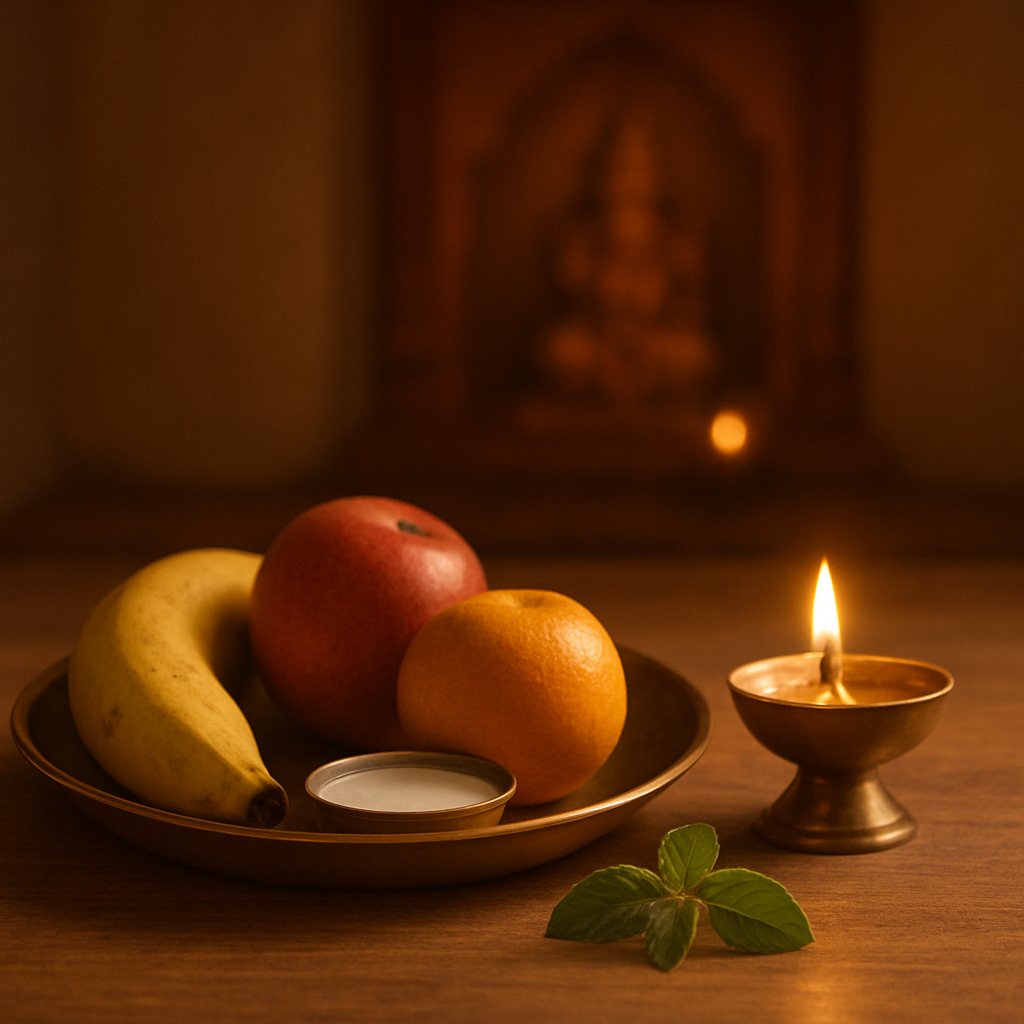
The central observance of Ekadashi is fasting, and in particular the avoidance of grains and beans — rice, wheat, lentils, and the like. Many devotees take only fruit, milk, and certain permitted foods, while the most rigorous keep a complete fast. The day is kept simple and prayerful, with extra time given to chanting, reading, and worship of Vishnu.
The fast is traditionally broken the following morning, on dwadasi, the twelfth day, within a prescribed window of time. Beyond the dietary discipline, the spirit of the day is one of restraint and remembrance — turning down the volume of ordinary appetites so that the attention can rest more fully on the Lord. Kept regularly, Ekadashi becomes a gentle, recurring purification of body and mind.