Brahmotsavam Explained
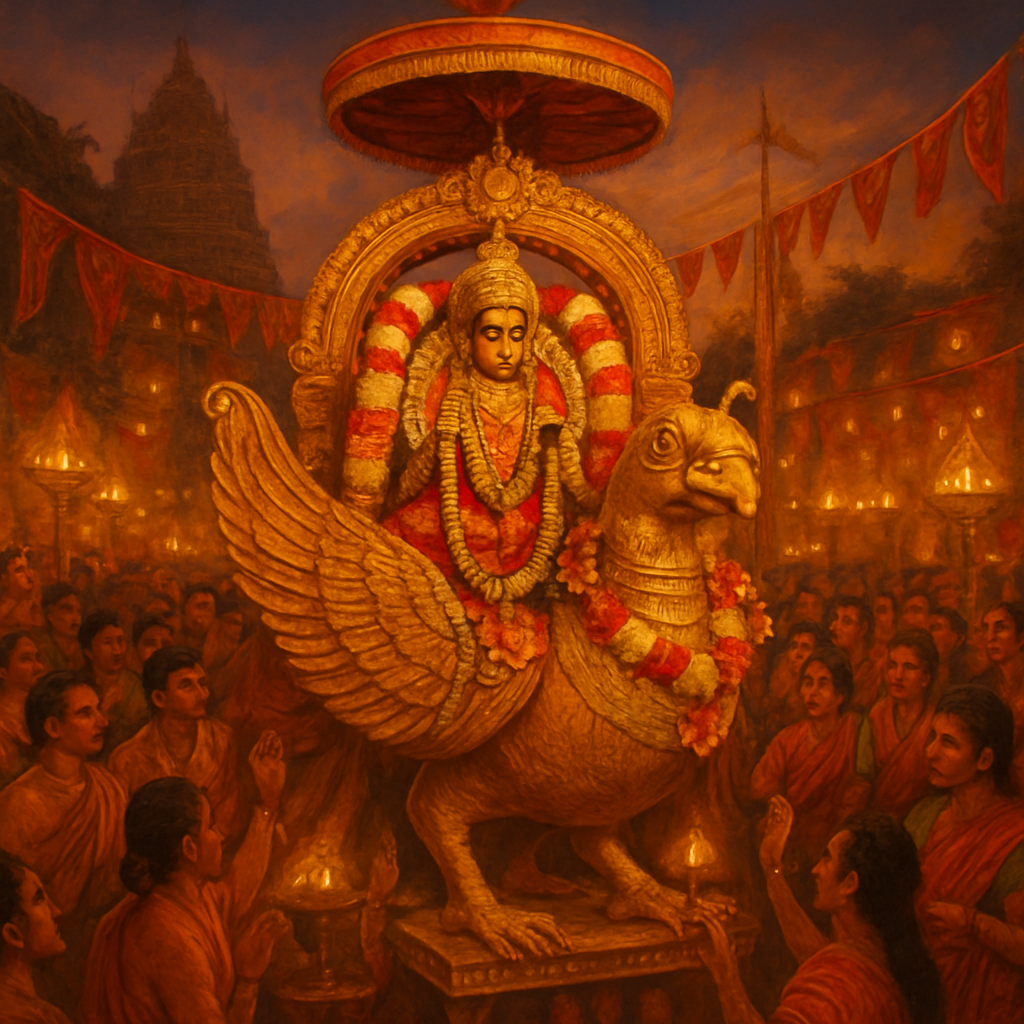
Brahmotsavam is the most important annual festival at Tirumala, drawing enormous crowds over nine days of processions, music, and ritual. Its very name points to its scale: it is said to have first been conducted by Brahma, the creator, in gratitude to the Lord — a festival of cosmic rather than merely local significance.
For the nine days, the festival brings the deity out from the sanctum into the streets, where even those who cannot enter the inner shrine can receive his darshan. This guide outlines what happens during Brahmotsavam, the meaning behind the daily processions, and why each stage matters.
A festival in the streets
For most of the year, worship at Tirumala centres on the fixed deity in the sanctum. During Brahmotsavam, the focus shifts to the utsava murti — the festival image of the Lord, who is carried out twice daily in grand procession around the temple streets. This is the festival’s essential gift: the Lord comes out to meet the gathered devotees, and the whole town becomes the temple.
The celebration begins with the hoisting of the Garuda flag (Dhwajarohanam), formally inviting the gods to attend, and proceeds through nine days of ritual, each with its own character and crowds.
The vahana processions
The heart of each day is the vahana procession. The processional deity is carried on a different vahana, or divine mount, for each session — the Sesha (the serpent), the Hamsa (swan), the Simha (lion), Garuda (the eagle), Hanumantha, Gaja (elephant), the Surya and Chandra prabha (sun and moon), and others. Each vahana is richly decorated and carries its own symbolism, depicting a different aspect of the Lord’s glory and his relationships with his devotees and attendants.
Watching the sequence over the nine days is like reading the Lord’s many facets in turn — his sovereignty, his grace, his valour, and his accessibility — each expressed through the mount he rides and the way he is adorned.
Garuda Seva
The Garuda Seva, on the fifth night, when the Lord rides his great eagle mount Garuda, is the most anticipated event of the entire festival. Garuda is Vishnu’s own vehicle and the king of birds, and to behold the Lord upon him is considered especially auspicious. This single procession draws the largest gatherings of the year, with devotees arriving from across the country for a glimpse.
Rathotsavam and Chakrasnanam
As the festival nears its close, the chariot festival (Rathotsavam) sees the Lord drawn through the streets on a towering wooden ratha pulled by devotees — participation in the pulling is itself regarded as a blessing. The celebration concludes with the Chakrasnanam, the ceremonial holy bath of the Lord and the Sudarshana chakra, which formally brings the nine days to rest.
Brahmotsavam usually falls in the Tamil month of Purattasi (September–October). For pilgrims, timing a visit to coincide with it — especially the Garuda Seva — turns an ordinary darshan into a participation in the temple’s grandest annual rhythm.