Understanding the Venkateswara Suprabhatam
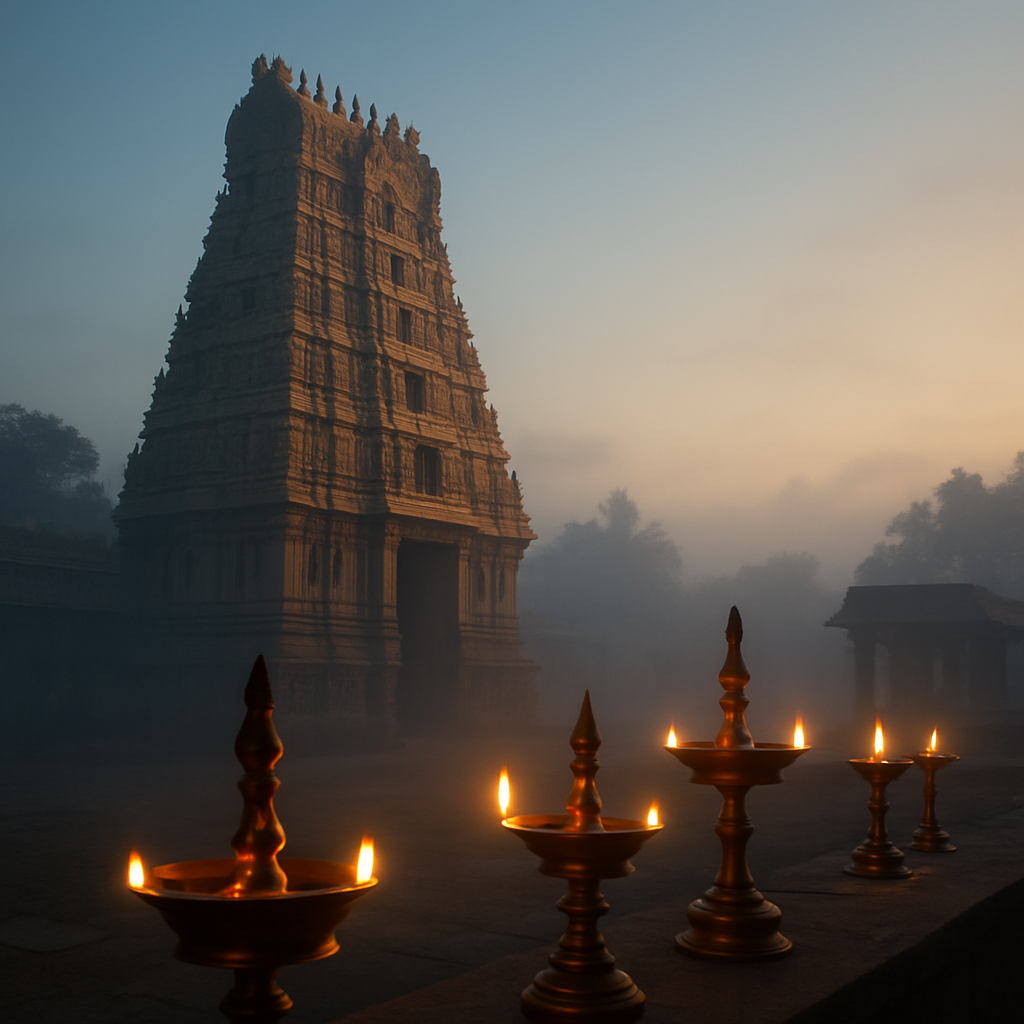
The Venkateswara Suprabhatam is among the best-loved devotional compositions of South India, traditionally sung at first light to gently awaken the Lord for the day’s worship. For countless households the celebrated recording by M. S. Subbulakshmi is, quite literally, the sound of morning — a melody that has woken families to prayer for generations.
Yet many who love the hymn have never paused over its words. This guide explains what the Suprabhatam is, where it came from, how its four parts fit together, and how to make it a living part of your own mornings.
What "Suprabhatam" means
Suprabhatam means "auspicious dawn" or "good morning." The genre belongs to a tender strand of devotion in which the Lord is treated not as a remote cosmic power but as a beloved guest residing in the temple, who is woken each morning with soft, respectful verses — much as one might gently rouse an honoured elder.
The opening verses address the Lord directly, inviting him to wake as the night ends, the birds begin to sing, and the day’s service is prepared. This intimacy — waking the divine with affection rather than awe — is the emotional heart of the hymn.
Its history and author
The Suprabhatam was composed in the fifteenth century by Prativadi Bhayankaram Annan (Annangaracharya), a devoted disciple in the Sri Vaishnava tradition. Modelled in part on an earlier Ramayana dawn-hymn, it was written specifically for the awakening service of Lord Venkateswara at Tirumala, where it continues to be sung at the temple to this day.
Its journey into nearly every South Indian home owes much to the twentieth-century recording by M. S. Subbulakshmi, whose rendition carried the hymn far beyond the temple walls and fixed it in the daily life of millions.
The four parts
The composition unfolds in four sections, each with its own mood. The Suprabhatam proper (the awakening verses) gently rouses the Lord. The Stotram offers praise, recounting his glory and his presence on the hills. The Prapatti expresses prapatti — total surrender — placing the devotee entirely at his feet. The closing Mangalasasanam pronounces auspicious benedictions, wishing well-being upon the Lord and, through him, upon all.
Together the four move in a natural arc: from waking the Lord, to praising him, to surrendering to him, to invoking blessings. To recite or hear them in sequence is to traverse that whole devotional movement each morning.
Reciting it at home
Many devotees play or recite the Suprabhatam at dawn as the first act of the day, often while lighting the lamp and beginning the morning puja. No special qualification, initiation, or perfect Sanskrit is needed — sincere, attentive listening is itself considered a complete form of devotion.
If you are new to it, begin by simply playing a trusted recording each morning and following along with a translation a few times. Gradually the verses become familiar, the meaning surfaces, and the hymn turns from background sound into a felt daily offering at the Lord’s waking.