The Iconography of Venkateswara
Hindu sacred images are a visual language. Every attribute a deity holds, every gesture of the hands, every mark on the body communicates something specific about who they are and what they offer the worshipper. To the trained eye, a murti is a text to be read as much as an image to be admired.
Learning this language deepens both worship and appreciation: it turns a glance into recognition, and recognition into relationship. This guide explains the key iconographic features of Lord Venkateswara — feature by feature — so that you can identify his form and understand what each element is saying.
The chakra and the shankha
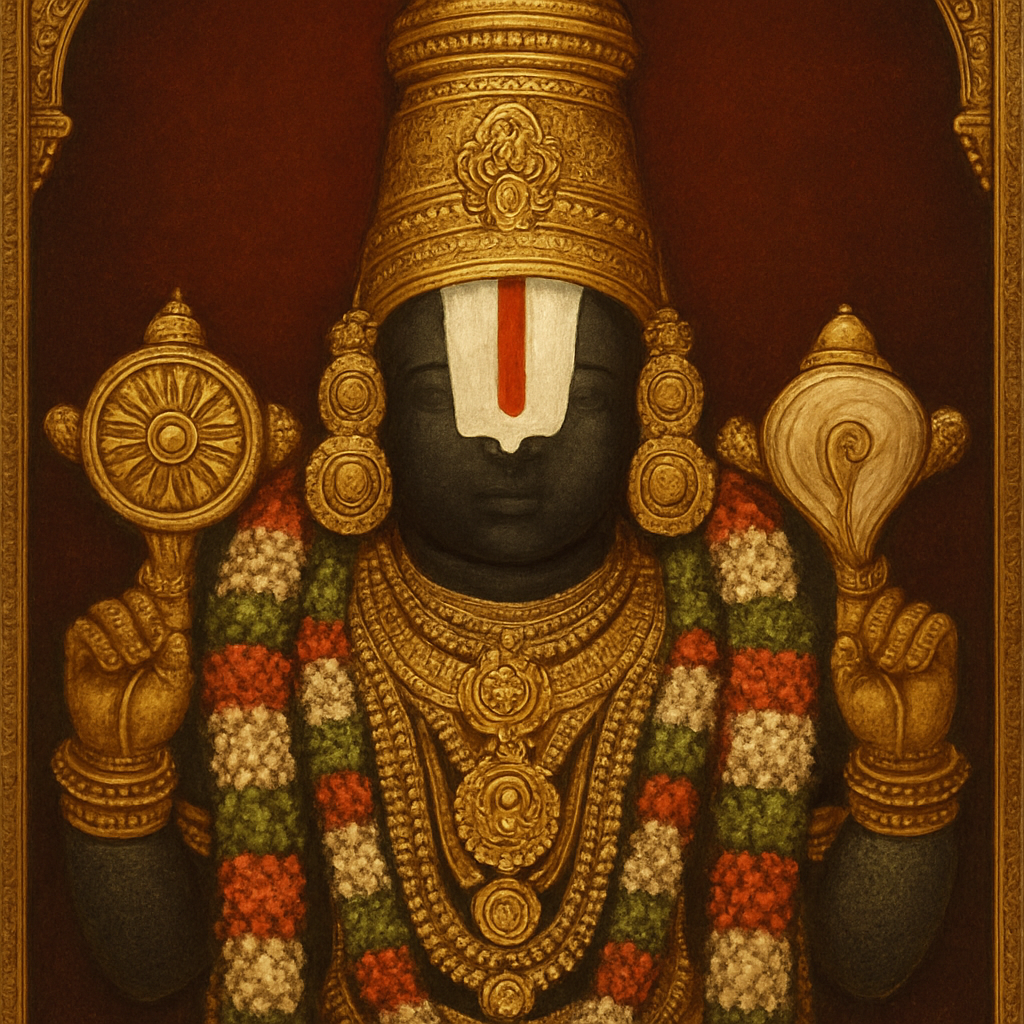
In his upper two hands the Lord holds the Sudarshana chakra (discus) and the Panchajanya shankha (conch) — the classic, defining emblems of Vishnu. Wherever you see these two attributes together, you are looking at a form of Vishnu, and at Tirumala that form is Venkateswara.
The chakra represents the wheel of cosmic order, time, and the relentless destruction of ignorance and evil; it is the Lord’s power to cut through illusion. The shankha represents the primordial sound, the sacred "Om" from which creation unfolds, and its call is understood to drive away negativity. Together they declare the deity’s sovereignty over both the order of the cosmos and the sound that underlies it.
The namam and the crown
The prominent white-and-red urdhva pundra — the namam — drawn vertically on the forehead is the unmistakable mark of a Vaishnava deity. The two white lines represent the feet of the Lord, and the red line between them represents Lakshmi, the goddess seated at his chest. At Tirumala the namam famously covers the deity’s eyes almost entirely, a feature of the sanctum image itself.
Above, the richly jewelled kiritam (crown) and the abundance of gold ornaments reflect his identity as Srinivasa, the consort of Lakshmi and the master of all wealth. The ornamentation is not decoration for its own sake; it signals his royal, sovereign nature as the lord who carries the goddess of fortune with him.
The hand gestures
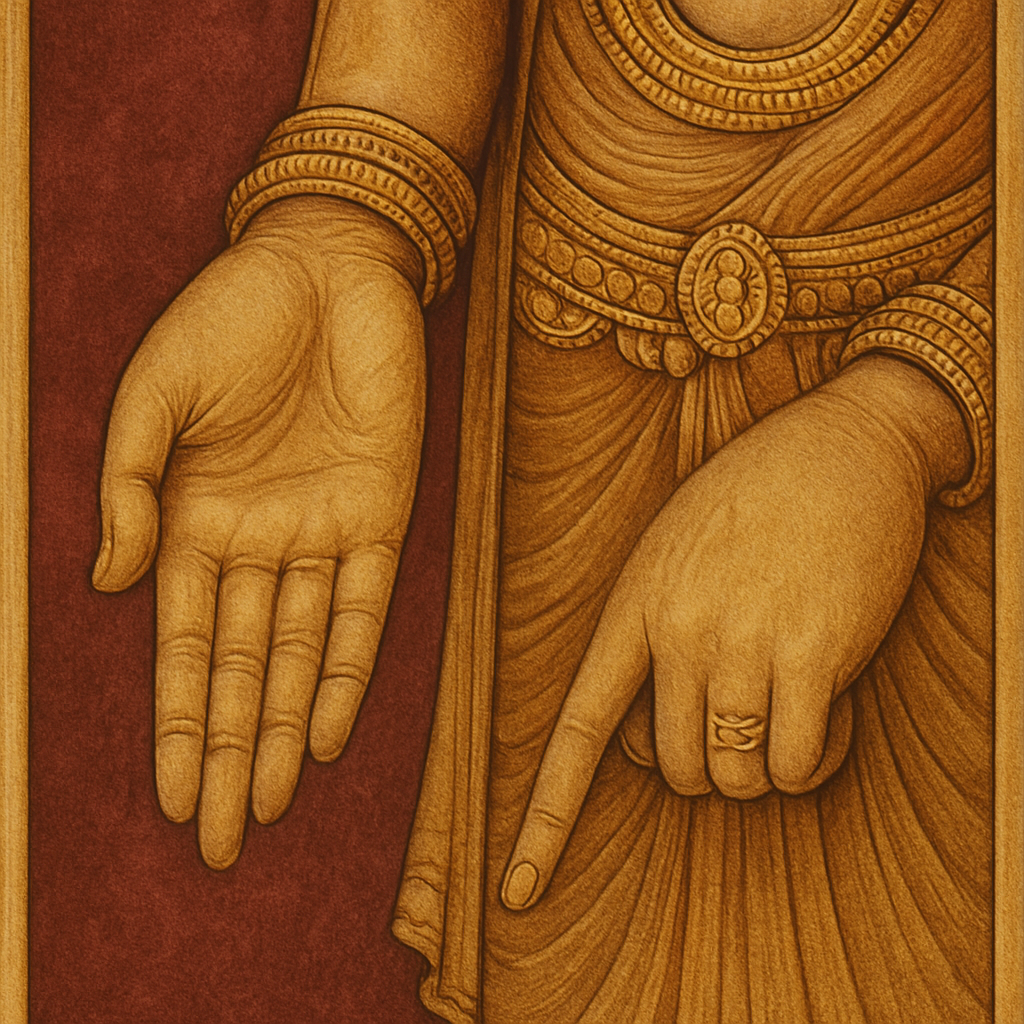
The two lower hands carry the deity’s message to the devotee. One hand is held in the varada mudra — palm turned outward and downward — the gesture of granting boons and bestowing grace. The companion gesture, abhaya mudra, raises the palm to say "do not fear": a promise of protection.
Most distinctively, one hand points downward toward the Lord’s own feet. This is the kati-hasta or the gesture of refuge: an invitation to the devotee to surrender at his feet, where the burdens of life can be set down. In many depictions this single gesture is treated as the heart of the whole image — the Lord himself indicating the place of safety.
Reading the whole image
Put together, the iconography tells a complete story: the chakra and conch establish that this is Vishnu, sovereign over cosmos and sound; the namam and crown identify him as Srinivasa, bearer of Lakshmi and lord of wealth; and the lower hands turn outward to the worshipper with the promise of grace, fearlessness, and refuge.
This is why devotees value an accurate image. A faithful murti or picture is not merely "correct" — it preserves the full message the tradition intends, so that every time the worshipper looks, the same teaching is silently repeated. When you next stand before an image of Venkateswara, read it from the upper hands down to the feet, and the form will speak.