Temple Architecture of South India
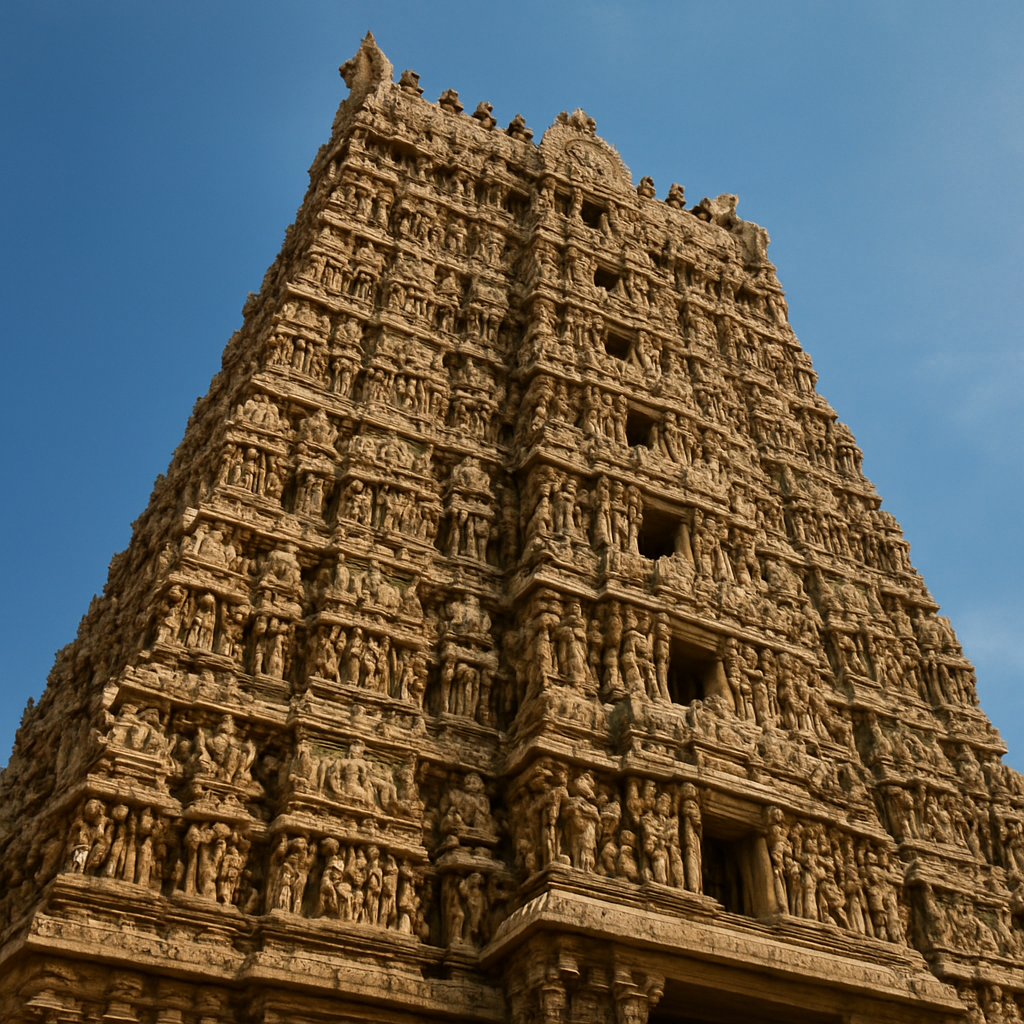
South Indian temples follow the Dravidian style, with soaring gateway towers and a sequence of carefully ordered spaces that draw the worshipper steadily inward toward the sanctum. To the first-time visitor a great temple can seem a bewildering maze, but its plan is in fact highly logical and deeply symbolic.
Learning to read that plan transforms a visit: the layout itself tells a story, leading from the bustling outer world to the still, dark heart where the deity dwells. This guide explains the main elements so you can understand the temples you visit.
The gopuram
The gopuram is the monumental gateway tower that rises over a temple’s entrance, often the tallest structure for miles and visible long before the temple itself. Its tiers are densely covered with sculpted figures — deities, guardians, celestial beings, and scenes from sacred story — painted in vivid colours at many temples.
The gopuram marks the threshold between the everyday world and the sacred precinct. To pass beneath it is to leave ordinary space behind and enter a domain set apart for the divine. Great temples often have several concentric gopurams, growing in significance as one moves inward.
The sanctum and vimana
At the heart of the temple is the garbhagriha — literally the "womb-chamber" — a small, dark, enclosed sanctum that houses the main deity. It is deliberately plain and unlit compared to the elaborate halls around it, so that all attention rests on the image within. Directly above it rises the vimana, the tower that crowns the sanctum.
At Tirumala this tower is the celebrated Ananda Nilayam, the gilded vimana plated in gold that glows above the shrine of Venkateswara. The contrast is intentional and profound: the most lavish, golden exterior shelters the most simple and sacred inner space.
Halls and circumambulation
Between the gateway and the sanctum lie pillared halls called mandapas, where devotees gather, rituals are performed, and festivals unfold. Surrounding the sanctum are enclosing corridors, the prakaras, which allow devotees to perform pradakshina — circumambulating the deity in a clockwise direction as an act of worship.
This movement is central to the temple experience: the worshipper does not simply approach the deity but walks around it, keeping the sacred centre always to the right. The concentric plan — gopuram, halls, prakaras, sanctum — thus guides both the body and the mind on a journey from the outer world to the still divine core.