Who Is Lord Venkateswara?
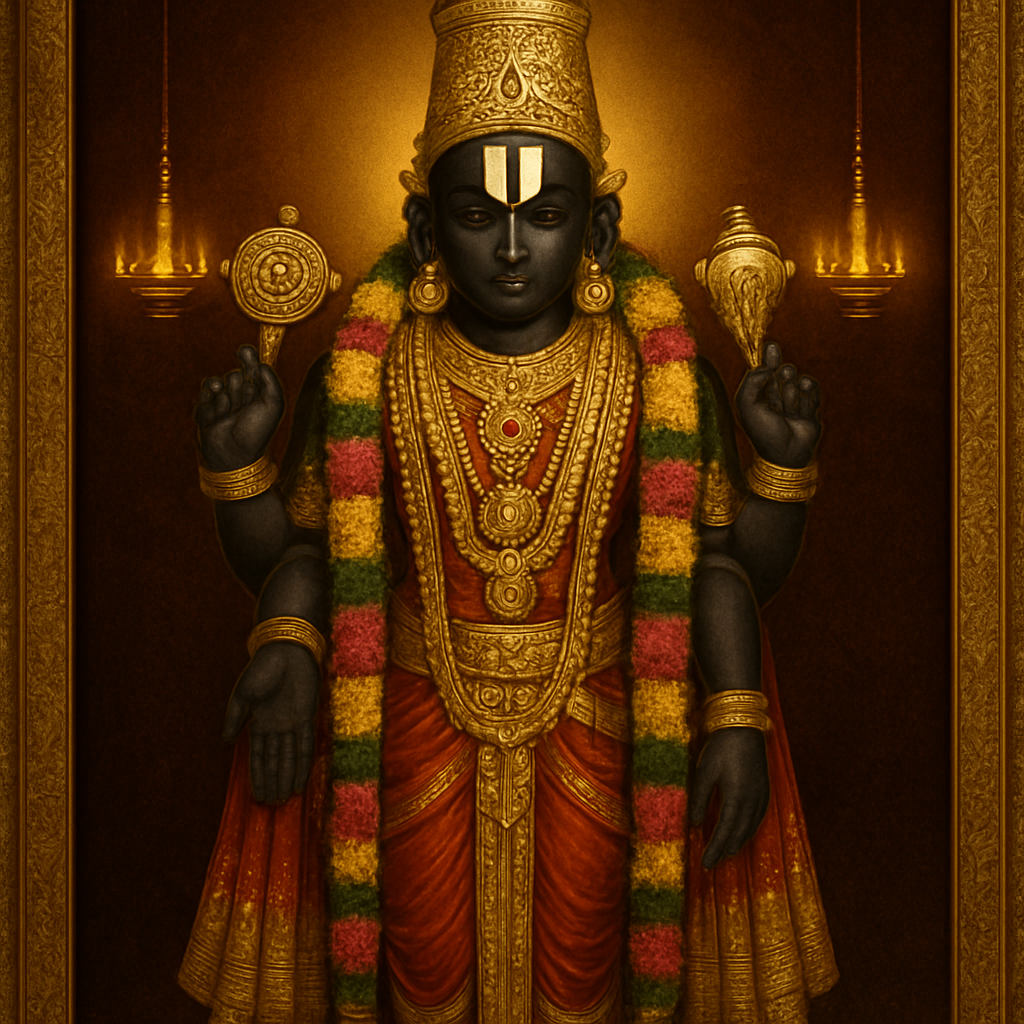
Lord Venkateswara is among the most revered forms of Vishnu in South India, worshipped at the hill shrine of Tirumala in Andhra Pradesh. Devotees know him by many names — Balaji, Srinivasa, Govinda, and Ezhumalaiyan, the lord of the seven hills. To his devotees he is not a distant cosmic abstraction but a living presence who receives, listens, and responds.
Each year, tens of millions of pilgrims climb to Tirumala to stand for a few moments before his image. That single fact — the sheer scale and persistence of this devotion across centuries — is the best introduction to who Venkateswara is. This guide explains his identity, where his worship comes from, what his many names mean, and why his shrine occupies such a singular place in the Hindu world.
The deity of the Kali Yuga
Traditional belief holds that Venkateswara manifested on earth to protect and guide humanity through the Kali Yuga, the present age of moral and spiritual decline. In an age when elaborate Vedic ritual and long austerity are difficult, he is understood as the form of the Lord who can be reached simply — through sincere devotion, the chanting of his name, and a pilgrimage to his hill.
This accessibility is central to his appeal. Where some forms of the divine are approached through scholarship or strict ritual purity, Venkateswara is felt to hear the prayers of ordinary people: the farmer, the merchant, the family seeking blessings for a child or a marriage. The vow, or mokku, made before him — often a gift of hair, money, or service in return for a prayer fulfilled — expresses this direct, personal relationship.
The name "Venkateswara" is traditionally explained as the lord (Ishwara) who burns away (ven) the sins (kata) of those who worship him. To take his darshan, devotees believe, is to be unburdened.
Puranic origins on the seven hills
The story of Venkateswara is told in the Venkatachala Mahatmya, a section of the Puranic literature devoted to the glory of the Tirumala hills. It is closely tied to the Varaha avatar of Vishnu — Varaha is said to have preceded the Lord on the hill, which is why pilgrims traditionally visit the Varaha shrine before the main temple.
These accounts describe how the Lord came to dwell on the Seshachalam range — seven hills understood as the coils of Adishesha, the serpent of Vishnu, made manifest as earth and stone. The geography itself is therefore considered sacred: the hills are not merely the setting for the shrine but a form of the divine.
Woven through these texts is the story of Srinivasa’s marriage to Padmavati and the loan he took from Kubera, the lord of wealth, to fund the wedding. Devotees’ offerings, it is said, help repay that eternal debt — a narrative that frames the famous wealth of the shrine as an act of devotion rather than mere riches.

The many names of the Lord
Devotees call upon the Lord with a wealth of names, each carrying a layer of meaning. As Srinivasa, he is "the one in whom Lakshmi (Sri) resides" — the goddess of fortune dwells on his chest. As Balaji, he is approached with affectionate familiarity. As Govinda, the name echoes endlessly through Tirumala in the cry "Govinda! Govinda!" that pilgrims raise as they climb and as they near his presence.
Tamil devotees know him as Ezhumalaiyan, lord of the seven hills, and as Perumal. Each epithet opens a different door to the same reality: his relationship with Lakshmi, his role as protector, his lordship over the sacred geography, and his nearness to those who call on him.
Learning these names is itself a form of devotion. To chant them is to recall the qualities they describe — and for many devotees the simple, repeated remembrance of the name is the heart of their practice.
Why his shrine stands apart
The temple at Tirumala is among the most visited religious sites on earth and one of the most generously endowed, sustained by the offerings of countless devotees. Yet what draws people is not its wealth but the experience of darshan — the brief, charged moment of standing before the deity in the sanctum.
For a first-time visitor, understanding who Venkateswara is transforms that moment from sightseeing into encounter. The crowds, the chant of "Govinda," the offered hair, the long climb — all of it is the outward shape of an inward relationship between the Lord of the seven hills and those who come to seek him.